Cookies are small text files that are placed on your computer by websites that you visit.
They are widely used in order to make websites work, or work more efficiently, as well as to provide information to the owners of the site.
This website makes use of cookies to monitor visitor sessions.
No personal information is stored in the cookie that is issued by the site.
The value stored in the cookie is an anonymous identifier, which is not linked to any other personal information you may give us during your visit.
If you do not wish to receive these cookies you can disable them in your browser, though doing so may affect the functionality of our website.
Most web browsers allow some control of cookies through the browser settings.
To find out more about cookies, including how to see what cookies have been set and how to manage and delete them, visit www.allaboutcookies.org (opens in a new window).
New Features in PERMAS Version 21
The new Version 21 of PERMAS and VisPER is available from July 2026. It offers significant improvements in the areas of contact modeling,
contact multigrid solvers, dynamic analyses, as well as data handling and optimization.
For more information take a look the Short Description.
Further details can be found in the comprehensive Product Description.
The most important new PERMAS features:
A new binary model format based on the HDF file format reduces file size and accelerates model import.
Contact analysis introduces automatic surface splitting at large kinks substantially reducing modeling effort and improving efficiency and robustness.
The new automatic search of contact partners dramatically speeds up contact modeling, makes the use of contact analyses more accessible, and significantly increases overall modeling efficiency and reliability.
A completely new stabilized contact algorithm with great improvements in terms of stability and performance was developed for frictional contact problems.
The definition of loads for a transient response analysis now supports a variety of new features including automatic translation of PSD signals to the time domain and filter options.
Extensions and improvements of the direct random response analysis greatly improve performance and are useful e.g. with the new frequency-dependent materials.
The new direct fluid-structure coupled timehistory enables fully-coupled analysis for high frequency tasks, e.g. underwater acoustic for ships, noise-generation from brake squeal and many more.
New features in PERMAS-OPT include fully integrated optimization based on fatigue-analysis results and a complete revision of the bead optimization method.
PERMAS-TOPO can now consider load patterns which are defined by a result combination rule and stresses at the integration points instead of the element-averaged stresses.
Direct matrix input now supports both symmetric and non-symmetric matrices, stiffness, mass and damping matrices.
Binary Model data
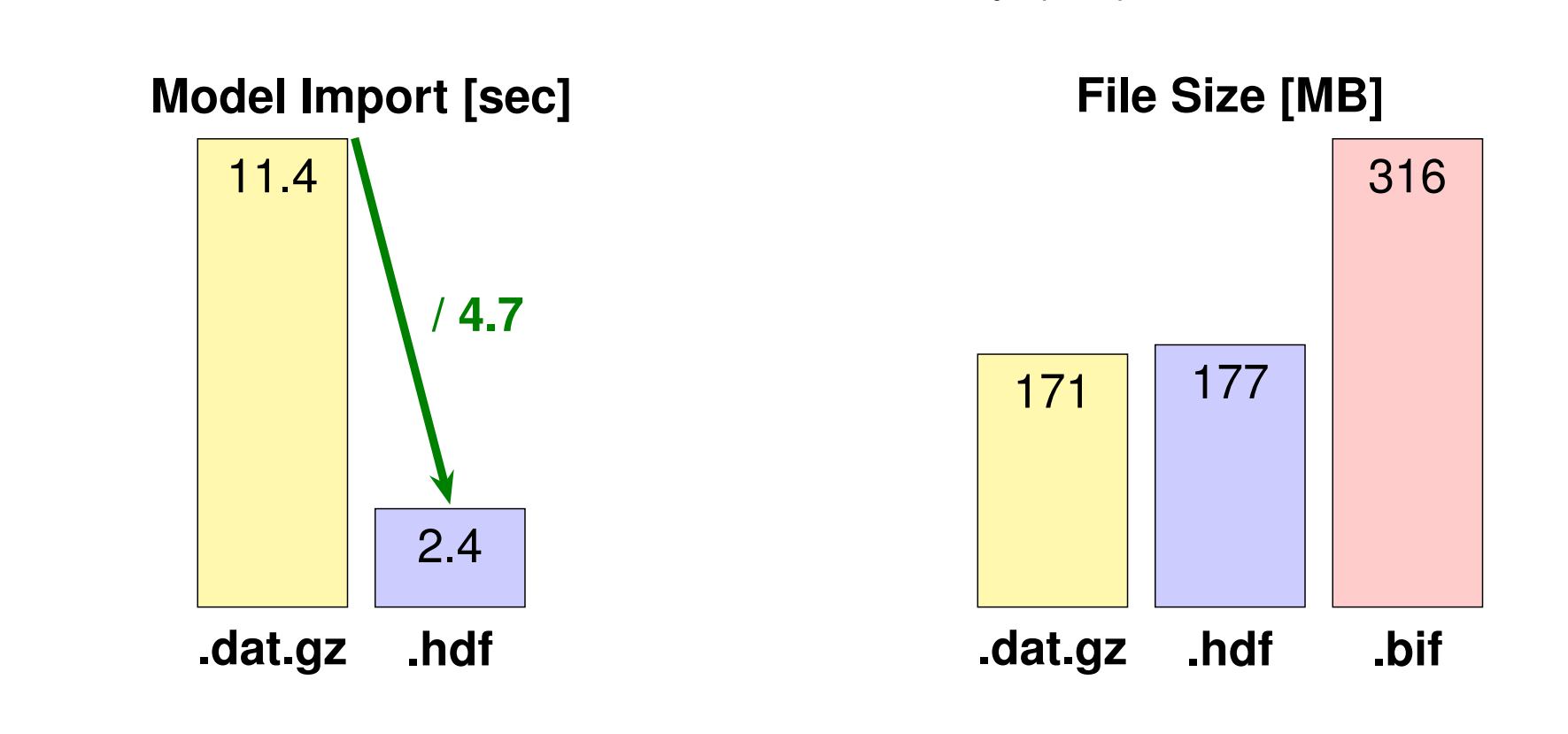
Performance for binary model with 4.5 Mio nodes & 2.5 Mio elements
A new PERMAS binary model format based on the HDF file standard
significantly accelerates model import.
A new PERMAS binary model format based on the HDF file standard significantly accelerates model import.
The right-hand diagram compares the file sizes of the PERMAS binary HDF format with the Medina binary (.bif) format
and a compressed ASCII DAT file (.dat.gz) for a model of 4.5 million nodes and 2.5 million elements.
The PERMAS binary model format reducies the storage requirements to about half of those of the Medina binary (.bif) format.
A single HDF file can store both model data and analysis results.
PERMAS and VisPER provide full read and write support for the PERMAS binary model format, enabling seamless data
exchange between preprocessing, analysis, and postprocessing.
Automatic Contact Surface Splitting
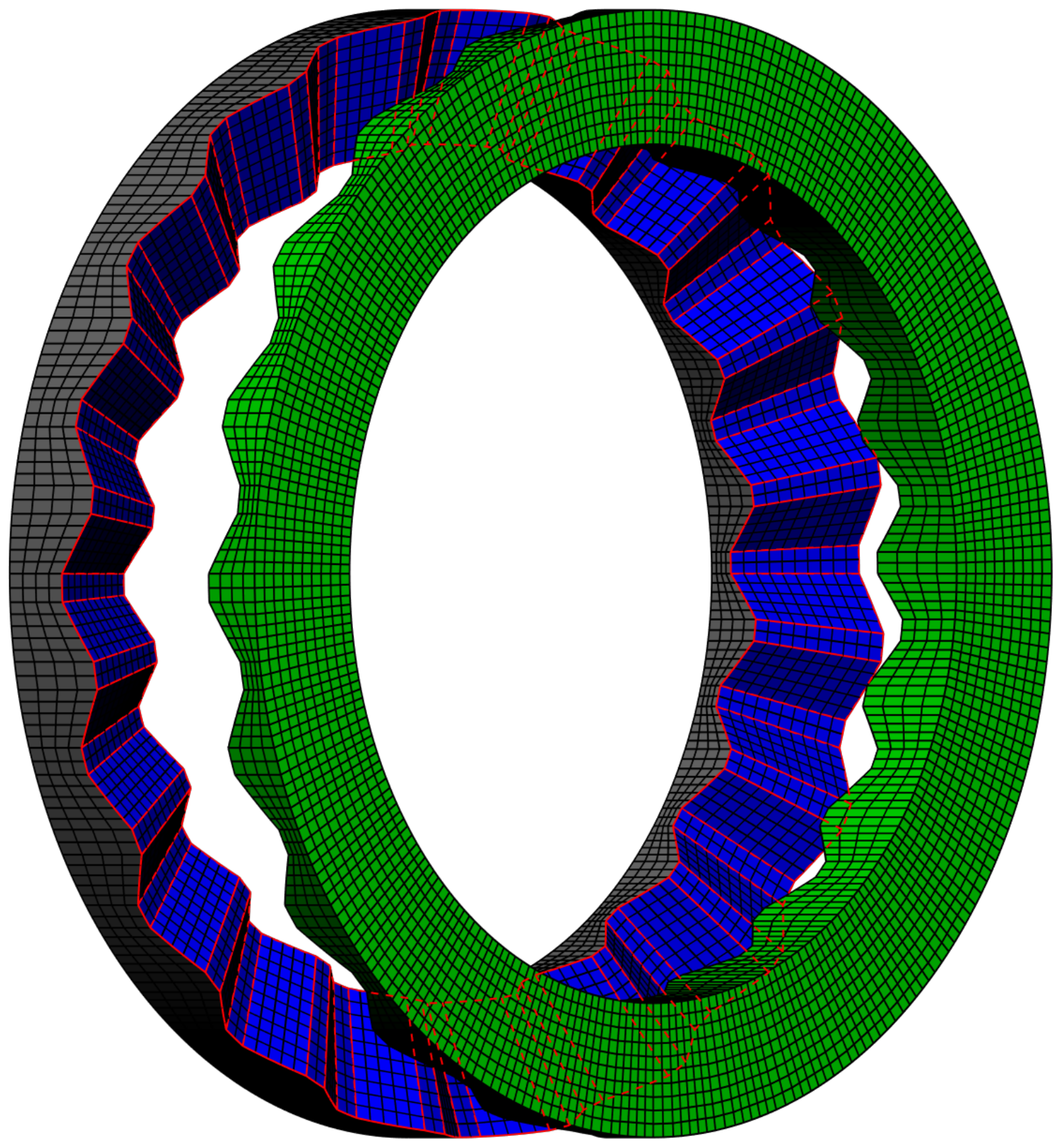
Previously, surfaces with pronounced kinks had to be manually split at physical surface boundaries to achieve accurate contact behavior.
The automatically generated split surfaces are now used directly in contact analyses.
Instead of smoothing contact normals across large kinks, they are treated as shared edges with separate normals on each side.
For the shown example only one surface per wheel is required.
In earlier PERMAS versions, a total of 168 surfaces had to be defined manually, corresponding to four surfaces per tooth for 21 teeth on each wheel.
Automatic Search of Contact Partners
The new contact definition $CONTACT AUTO automatically will find potential contact partners, introducing the necessary surfaces and the corresponding contact definitions in the model.
This feature dramatically speeds up contact modeling, makes the use of contact analyses more accessible, and significantly increases overall modeling efficiency and reliability due to:
one contact definition leads to many contacts, i.e. less effort is necessary to define contacts,
the automatic handling of contact normals, kinks and already defined MPCs leads to faster and more reliable contact modeling,
no manually modeling of surfaces is necessary,
for contact definitions with shells, the normal vector of the shell elements is automatically corrected if it does not match to the contact definition.
New Stabilized Algorithm Frictional Contact Problems
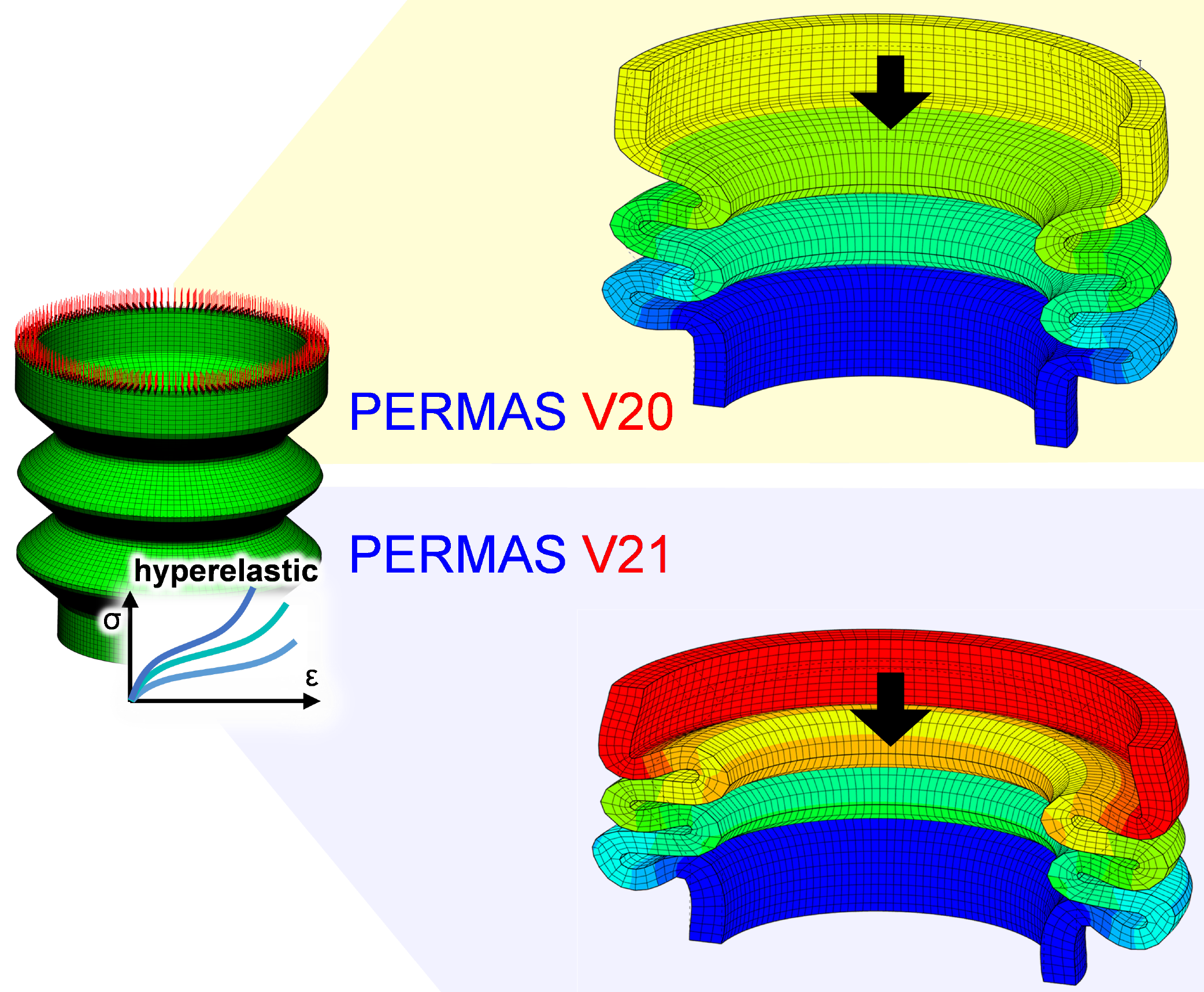
Contact analysis was extended to frictional contact problems.
The completely new innovative and extremly robust algorithm with high performance still accurately solves the Coulomb friction law.
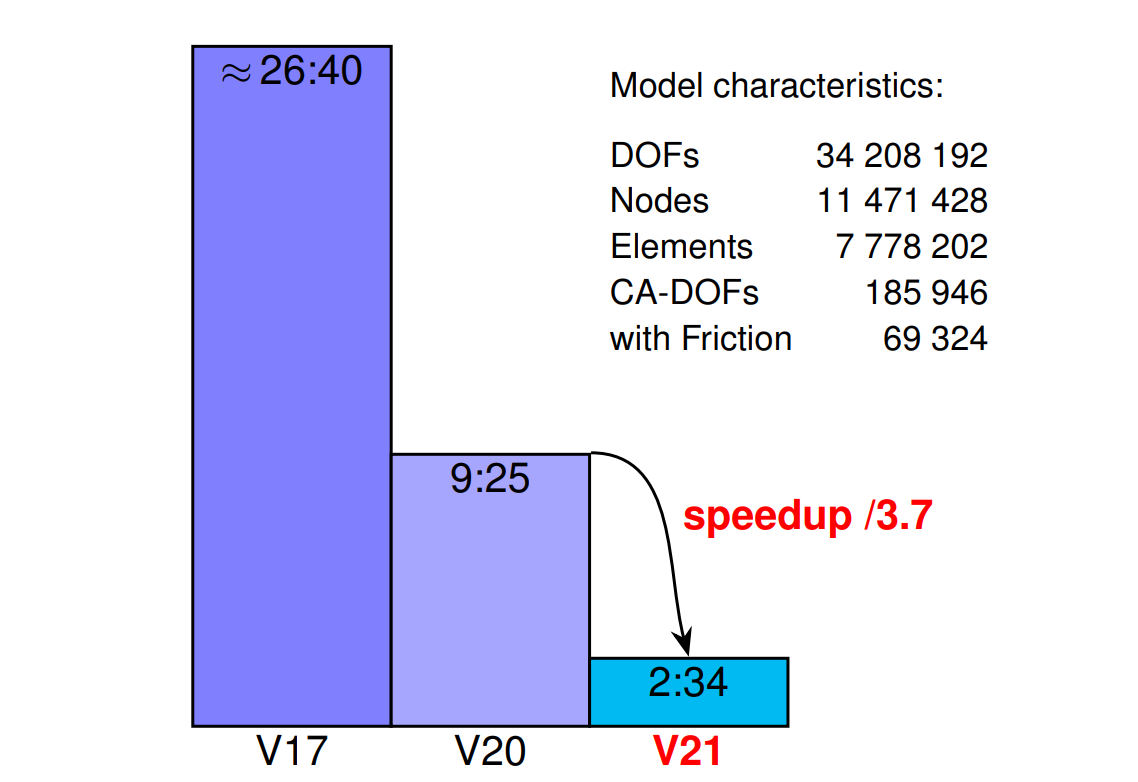
The continuous improvement of contact analysis w.r.t. stability, performance and functionality is illustrated in the figure to the right.
The runtime for a larger OEM Axle with friction and two time steps was improved by factor 11 from PERMAS Versions 17 up to Version 21.
New Solver for Nonlinear Material Analysis
A new default linear solver with more robust convergence criteria has been introduced leading to more stability and significant performance improvements.
New convergence criteria options where established to consider either only local DOFs or all DOFs, in either relative or absolute form.
Eigenpairs with negative Eigenvalues
The new parameter SIGN was added to the vibration analysis to also calculate eigenpairs with negative eigenvalues.
Negative eigenvalues may occur if the vibration analysis is run on a deformed system after a NLMATERIAL computation.
It may happen that the system is unstable, i.e. the stiffness matrix is not positive definite any longer.
The corresponding eigenmodes then are related to the instability and can be interpreted e.g. as buckling modes.
Distinguishing between Global and Local Mode Shapes
A new criterion for distinguishing between global and local mode shapes has been introduced.
The evaluation method for the globality can be selected and the limit factor for the calculation can be individually specified.
The classification results are provided in a dedicated table in the RES file, indicating whether each mode shape is identified as global or local.
MAC Factors for Complex Modes
MAC factors can also be computed for complex modes. Measurement data only delivers complex mode shapes.
MAC factors can now be computed for a single DOF. Often, measurements are limited to single translational DOFs, for example when using uni-axial accelerometers.
Also the global UCI switch MACDOFS was extended to single DOFs.
Reconstruct a Matrix Model from (Measured) Eigenmodes
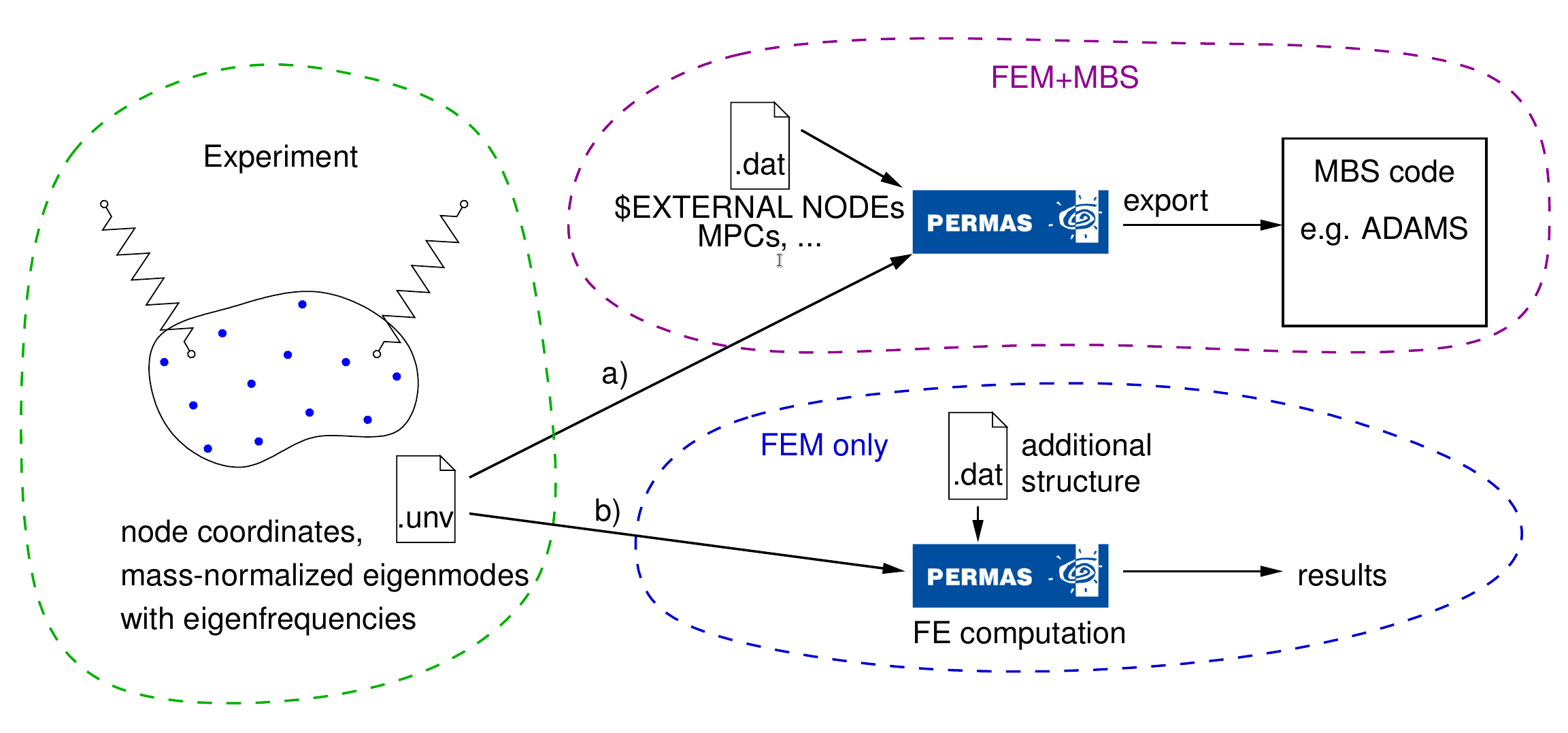
Workflow for Experimental Modal Analysis
PERMAS Version 21 offers a possibility to reconstruct a matrix model from (measured) eigenmodes.
The workflow is illustrated in the figure. The process of Experimental Modal Analysis (EMA) has the following properties:
Generate Matrix model from measured eigenmodes & frequencies (including rigid body modes).
Matrix model contains external and modal DOFs.
Matrix model can be used for computations in PERMAS or for export to e.g. MBS codes.
Many Additional Static Mode Shapes
The MLDR solver for vibration anlysis was adapted to deal with many additional static mode shapes, especially contact addmodes.
If a model with many contact definitions is simulated, the orthonormalization of thousands of contact addmodes will be very fast with the MLDR solver.
The MLDR solver is not only a big performance advantage for many elastic mode shapes, but also for many additional static mode shapes.
Dynamic contact and friction
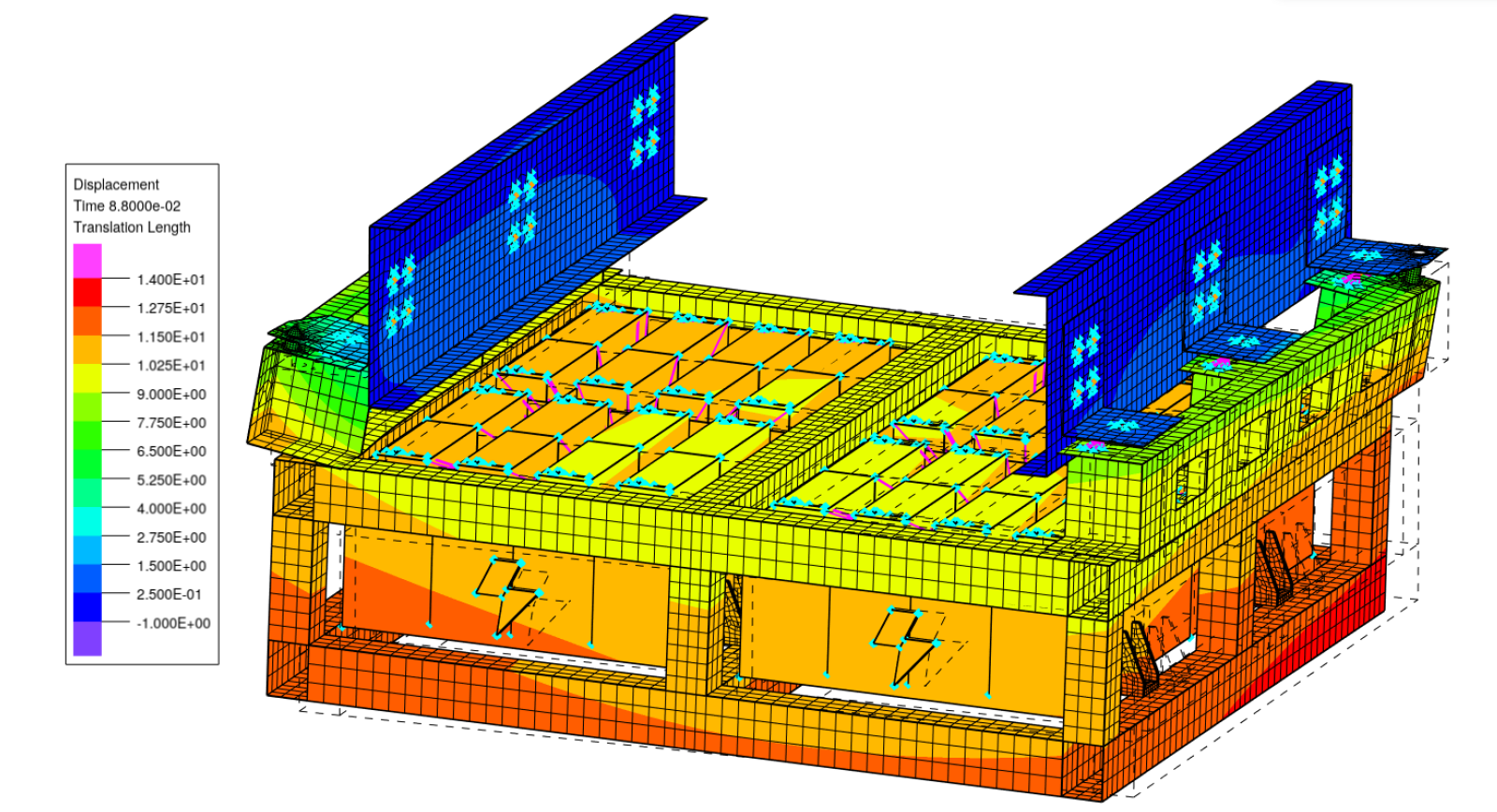
Dynamic contact example: Battery pack with Modal Timehistory
Dynamic contact and friction is now available in many dynamic analyses:
DIRECT TIMEhistory
DIRECT FSCoupled TIMEhistory
MODAL TIMEhistory
MODAL FSCoupled TIMEhistory
DIRECT HARMonic BALance
MODAL HARMonic BALance
MODAL FSCoupled HARMonic BALance
The contact is defined with $CONTACT as in static contact.
Dynamic contact is also supporting pretension loads with the option FORCE.
New Time Integration in Timehistory Analyses
Completely new time integration methods are now available in PERMAS in direct timehistory analyses:
The option SOLV = TWOSTEP is using the Bathe time integration method and offers high numerical dissipation and is well suited for nonlinear problems.
In the nonlinear case, the method is also fully implicit and enables the use of bigger timesteps.
The option SOLV = SEMIIMPLICIT additionally treats nonlinear forces explicitly.
The integration is only stable when the timestep is sufficiently small.
This condition is automatically checked for MODAL TIMEhistory and normal contact.
Extended Loads for Timehistory Analysis
The definition of loads for a transient response analysis has been greatly extended and is now supporting a variety of new features:
Prescribed velocities or accelerations may now be assigned.
It is now possible to define a power spectral density (PSD) signal which will be automatically converted to the time domain.
A bandpass filter may be used to remove unwanted frequency content or drift from velocity or acceleration signals.
Frequency-dependent Material
The options for frequency-dependent material have been greatly extended, including the elastic properties for rubber-like material
as well as compressibility and density for absorber materials in a fluid-structure coupled analysis.
The frequency-dependent materials are available for modal and direct analyses.
Excluding Rigid Body Modes from the Modal Basis
A new option controls the modal basis used for modal transformation.
When selected, only elastic and additional eigenmodes are included in the modal transformation, while rigid body modes are excluded from the modal space.
This helps to prevent unwanted drift caused by unintended excitation from the excluded modes.
In addition, no modal stresses are generated for rigid body modes, which is particularly beneficial for subsequent analyses, e.g. fatigue analysis.
Extended Random Response Analysis
The following new features and extension were done for Random Response analysis:
A completely new analysis, DIRECT RANDOM is now available.
This analysis enables direct calculation of random response without generation of a modal basis.
This is useful e.g. with the new frequency-dependent material properties.
The definition of a stochastic loads was revised and extended with new features:
If both power spectral densities and cross spectral densities are defined, the disk space usage is significantly reduced.
It now supports the option to directly assign a prescribed velocity or acceleration.
Extended Harmonic Balance Method
The Harmonic Balance Method (HBM) is a steady-state method for solving nonlinear differential equations which is used in nonlinear frequency response.
The following enhancements have been developed for this method:
A new stability criterion identifies stable and unstable solutions by evaluating the complex eigenvalues of the
Hill matrix, providing additional insight into the dynamic behavior of the computed periodic solutions.
The stability calculation is supported for direct and modal as well as fluid-structure coupled HBM analyses.
Two different methods are available to calculate the stability:
Imaginary value based sorting criteria,
Koopman-Hill projection method.
The stability analysis is optional and can be enabled by specifying the CEV parameter in the analysis command.
The selected value of CEV determines the stability method to be used.
HBM now supports a reduced harmonic ansatz allowing even harmonics to be excluded from the solution ansatz,
which is a valid assumption for systems with point-symmetric nonlinearities.
By reducing the number of harmonic components, computational efficiency can be significantly improved.
In addition, this feature enhances of HBM analyses for problems involving rigid body modes.
In modal HBM analyses a new option is available converting the structural damping to an equivalent viscous damping.
This is needed for stability calculation.
Changes and Enhancements in PERMAS FS
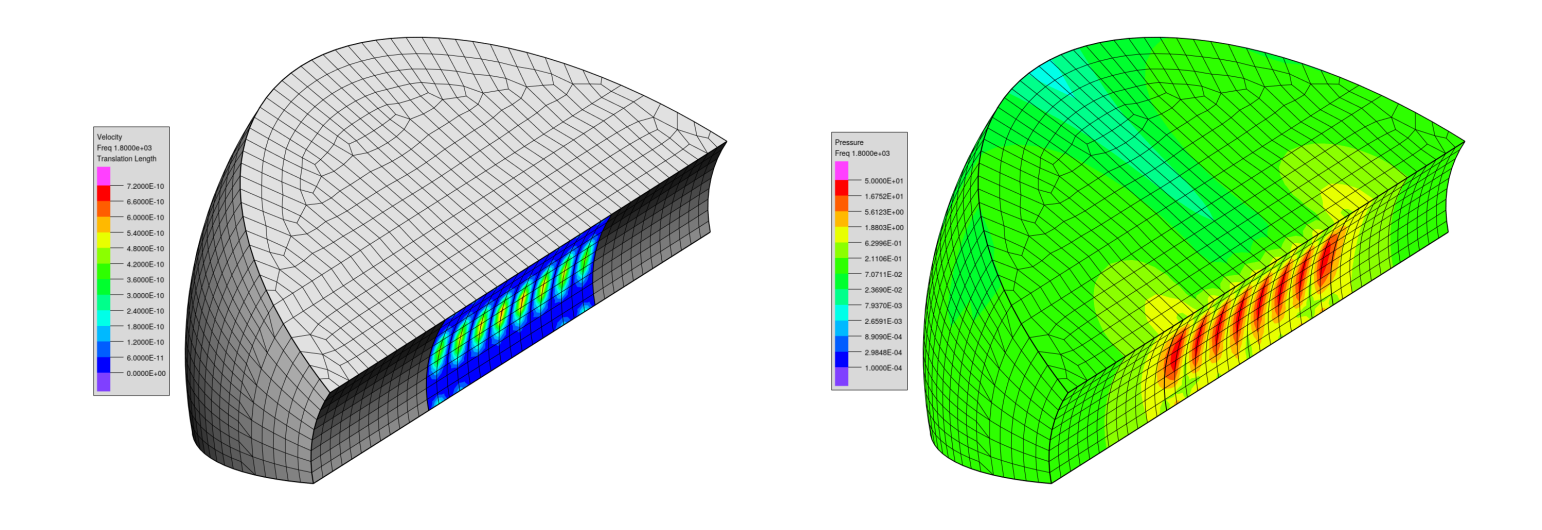
Velocity (left) and pressure distribution (right) at 1800.0 Hz
A completely new analysis type DIRECT FSCoupled TIMEhistory is now available.
This enables direct fully-copuled fluid-structure acoustic time analysis for high frequency problems.
This could be underwater acoustics for ships, noise-generation from brake squeal and many other applications.
A completely new analysis type DIRECT FSCoupled RANDOM is now available.
This enables direct fully-coupled fluid-structure acoustic analysis for random loads.
A special feature of this analysis is, that the user may specify an arbitrary hermitian spectral density matrix.
The direct fluid frequency analysis now supports an assembly situation.
Changes and Enhancements in PERMAS-OPT
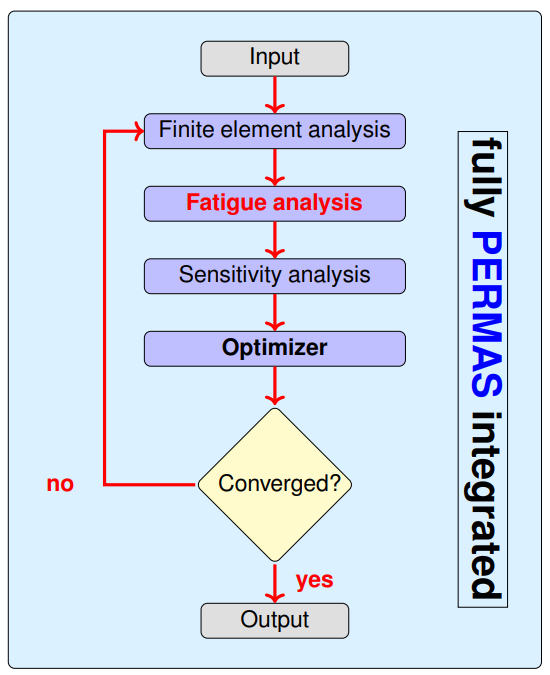
Fully integrated fatigue optimization workflow
A major new feature is damage-driven optimization based on results from a PERMAS fatigue analysis.
Damage may be defined either as an optimization objective or as a constraint, both locally and globally.
The complete workflow is fully integrated into PERMAS, providing an efficient and user-friendly
process that eliminates the need for data transfer between different software tools.
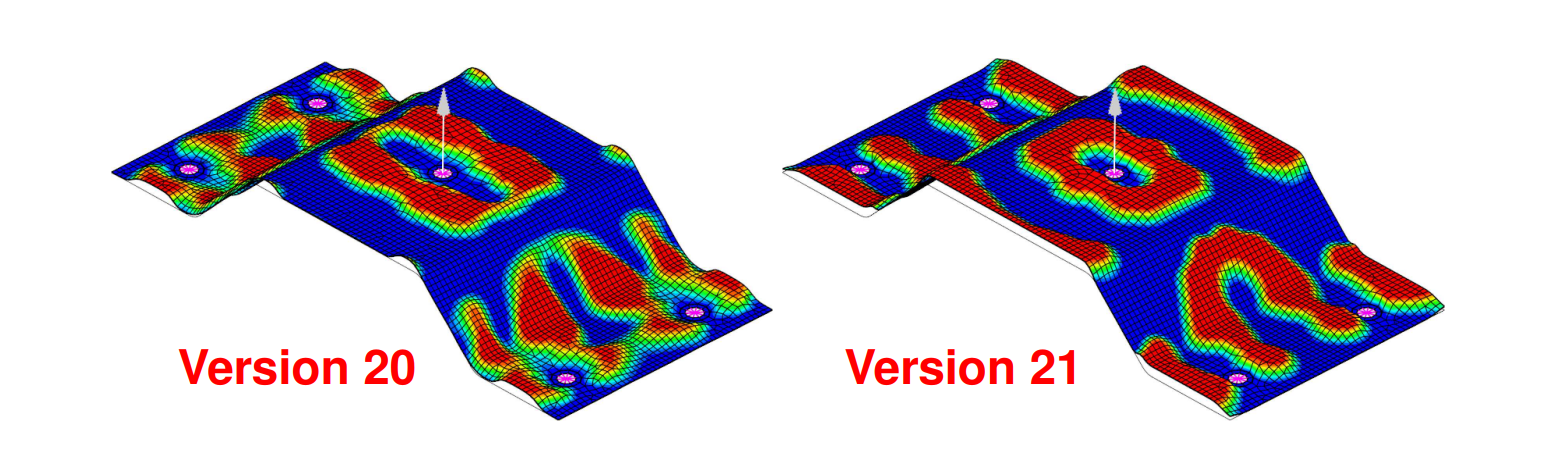
A second major new feature is a complete revision of the bead optimization method, with the following objectives:
Comparing bead optimization results between PERMAS V20 & V21
The new bead optimization method provides results that require significantly less design interpretation
and accurately realize the geometric bead properties specified by the user.
A GUI for setting up the bead optimization model, guiding the user through the input data required for the new optimization method, has been developed in VisPER.
An option for transforming the bead optimization results into a new model for further processing (e.g., reanalysis) has been implemented in VisPER.
The new method method generates significantly clearer and better-defined bead structures, eliminating the need for user-specific interpretation.
The user-defined bead properties, such as height and minimum width, are fully realized.
Together with the GUI for bead optimization setup (Bead Wizard) and the GUI for bead postprocessing (Bead Design Wizard), a convenient and user-friendly workflow is provided.
Optimization can now consider load patterns which are defined by a result combination rule.
Changes and Enhancements in PERMAS-TOPO
Optimization can now consider load patterns which are defined by a result combination rule.
Currently, the combined load cases must belong to the same situation.
For global stress-based topology optimization, a new option is available that considers stresses at the integration points
instead of the element-averaged stresses in the global aggregation function.
Using integration-point stresses leads to more realistic topology optimization results.
The optimized design typically exhibits lower actual maximum stress values and reduced localized stress concentrations
compared to approaches based on element-averaged stresses.